Karen Green–Ash Tree Lane house relationship
House of LeavesThe Karen Green–Ash Tree Lane house relationship is one of escalating fear that transforms the house from a family home into the material form of Karen Green’s private anxieties. Its impossible corridors and unstable boundaries do not merely threaten her physically: they intensify the distance between Karen and Will Navidson, expose the inadequacy of her protective routines, and finally force her to cross the threshold she has spent the story avoiding.
The House as a Threat to Domestic Safety
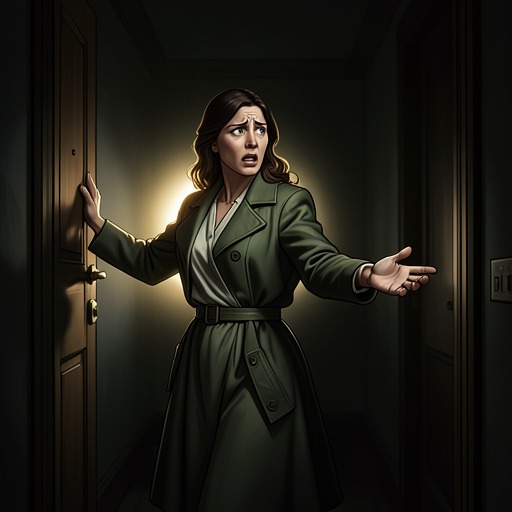
Karen’s fear first becomes unmistakable when Chad Navidson and Daisy Navidson’s voices echo from a dark, doorless hallway that has appeared in the living-room wall. The sound is impossible within the house’s stated dimensions: no room is longer than twenty-five feet, yet each child’s call receives a separate answer. Will enters the hallway and returns carrying both children, while Karen remains frozen at the threshold, unable to follow him into the darkness. The children are not especially disturbed and even want to go back, but Karen is drenched in sweat and holds them as though they have narrowly escaped catastrophe. Her response establishes the relationship’s central asymmetry: the house can appear adventurous or even entertaining to others, while for Karen it immediately becomes an invasion of the family’s most intimate space.
She asks Will to promise that he will not enter the passage again, and for the rest of the night keeps hold of his hand. The house therefore alters more than the floor plan. It changes the physical arrangement of the couple, making Will the person who can enter and return and Karen the person who must remain outside, waiting. The boundary of the corridor becomes a boundary within the marriage.
Fear, Intimacy, and the Marital Crisis
The house’s appearance coincides with a crisis that predates the supernatural events. After almost eleven years of Will’s foreign assignments, Karen has made reconciliation conditional on his abandoning his professional habits or losing his family. Unable to choose fully between exploration and domestic life, Will turns reconciliation itself into the subject of documentation. The house becomes the setting in which an already failing relationship is recorded rather than repaired.
Karen explains that sexual intimacy had initially returned after the family moved in: she and Will were intimate in the kitchen, shower, and garage. After the closet-like anomaly appeared, however, she could no longer bear being touched because the place terrified her. Will observes the same change from his side, describing a sudden refusal of physical contact that began after their return from Seattle. The house thus converts fear into bodily distance. Karen’s terror is not limited to the corridor; it enters the bedroom and makes ordinary gestures of affection feel dangerous.
Their disagreement is also a conflict over whose fear deserves authority. Karen wants Will to understand that she opposes his exploration because she loves him and senses that something is profoundly wrong with the place. Will knows that the house is connected to her fears and anxieties, yet feels consumed by his inability to enter it. He agrees not to go in because he loves her, while believing that she has given insufficient thought to what he himself wants. The result is a pursuit-and-withdrawal pattern: Will moves toward the forbidden space, Karen tries to hold him back, and the house becomes the object around which their incompatible needs circulate.
Attempts to Control the Uncontrollable Space
Karen tries to restore order through domestic and symbolic means. On August 11, 1990, while Tom Navidson helps Will photograph the hallway with a strobe, she stands outside speaking with Audrie McCullogh about Feng Shui and complains that the house continues to produce terrible energy despite its ceramic turtles, wooden ducks, goldfish, celestial dragons, and bronze lions. She considers finding a psychic, an exorcist, or a more capable real-estate agent. These objects and proposed authorities represent an effort to translate an impossible architectural problem into something that can be arranged, cleansed, diagnosed, or sold.
The effort fails in a literal way when the Feng Shui objects begin disappearing. Chad and Daisy lead Karen from room to room, pointing out the absent tiger, marble horses, and vase. In the kitchen she sits down on the verge of a panic attack, breathing rapidly with sweat covering her face. The loss of the objects strips away the visible machinery of denial. She no longer insists that Feng Shui can correct the house; the disturbance increasingly points toward the unresolved fissure between herself and Will.
Even basic orientation becomes impossible. Karen buys a compass after being told that accurate directions are necessary for Feng Shui, but the instrument refuses to settle on north, south, east, or west inside the house. She assumes the first compass is defective, exchanges it, and finds that the replacement is equally useless. The house defeats both architectural measurement and domestic ritual: its dimensions do not add up, and its interior cannot be located reliably within ordinary directional space.
From Avoidance to Entry
The house’s instability is repeatedly confirmed by the film. Karen discovers that the structure cannot be represented through normal means of determining direction, while the larger labyrinth can never be seen in its entirety and must be understood from within. The Infinite Corridor, the Anteroom, the Great Hall, and the Spiral Staircase exist for everyone, but their size and arrangement change; other areas refuse to reproduce the same pattern twice. The house therefore denies Karen the stable exterior viewpoint that might make fear manageable. There is no complete plan from which she can safely master the interior.
Her decisive confrontation occurs when she returns to the house searching for Will. She first points the Hi 8 at the upstairs bookshelves and finds them flush with the walls; the closet space has vanished. In the living room she approaches the door on the north wall, expecting the corridor or hoping that Billy Reston has somehow secured it. The door opens effortlessly, but behind it lies only a shallow closet, about a foot and a half deep, with white walls, molding, and daylight visible through the windows behind her. The disappearance of the corridor does not reassure her. Karen laughs, but the laugh breaks off because the object of her fear has vanished along with her apparent means of finding Will.
Later, when the real emptiness opens behind her, she does not scream. She retreats from the children’s bedroom, then returns with a halogen flashlight and stands at the edge, calling for Will. The recording contains no clear sound explaining why she stops, leaving open whether she hears something or whether her mind imposes a summons on the abyss. She finally steps into the darkness without announcement or dramatic preparation. The hollow space disappears a second later and is replaced by the wall as it had been before, except that the children’s drawings are gone.
Love, Memory, and the Relationship’s Meaning
Karen’s entry marks a reversal in the relationship. Earlier, fear had made her cling to Will, forbid his exploration, and withdraw from physical intimacy. At the final threshold, love becomes the force that allows her to move toward the very space associated with danger. The action is presented as overcoming not only the house but also memories of a dark well, alleged abuse by a stepfather, and whatever remains concealed in her childhood. The house functions as a gothic enclosure in which suppressed history and present marital conflict become spatially inseparable.
This does not make the house a simple symbol with one fixed meaning. Its corridors alter in size and layout; some spaces recur while others never repeat; and no observer can comprehend the whole from outside. The house’s resistance to stable representation mirrors Karen’s difficulty in defining a secure personal space within a family dominated by Will’s energy, authority, and documentary project. Will has abandoned foreign assignments but continues to occupy the home through his work, while Karen struggles to establish a territory that is genuinely hers.
By crossing the threshold, Karen does not master the architecture or receive a final explanation for it. Her achievement is relational and perceptual. She moves because she wants to embrace Will as she has never done before, and the act joins the house’s darkness to a renewed capacity to see him and herself. The Ash Tree Lane house remains impossible, but its terror has ceased to be only an obstacle: it has become the pressure through which Karen confronts dependence, memory, intimacy, and the cost of remaining outside.